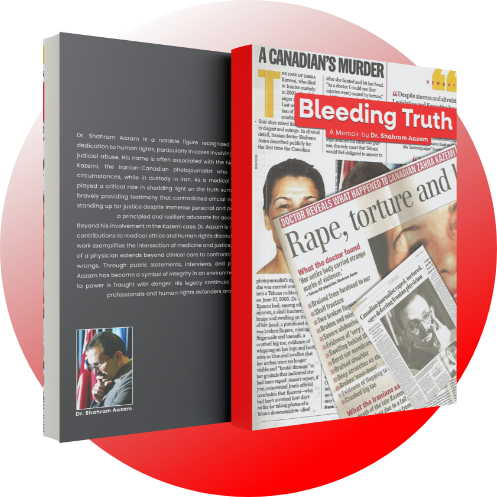
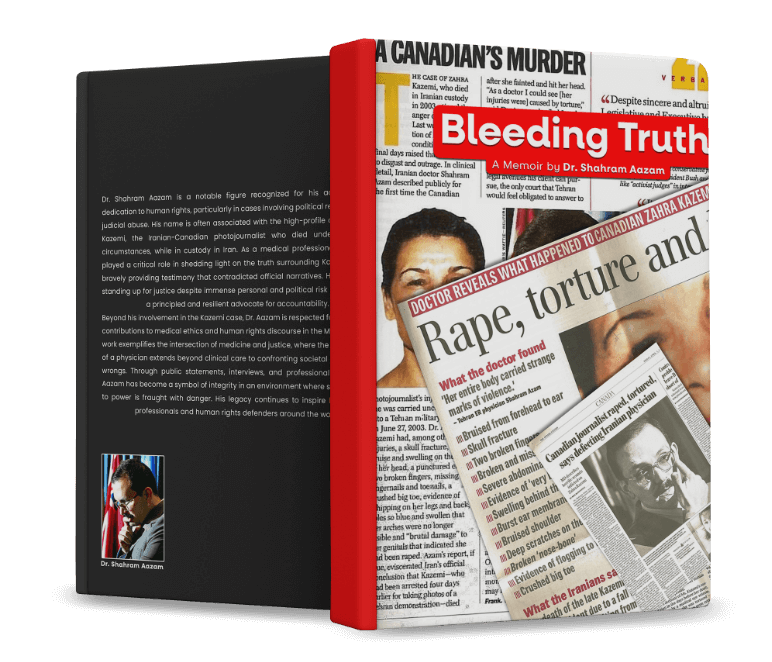
Bleeding Truth is a harrowing, deeply personal memoir that lays bare the human cost of authoritarianism, war, and exile—while also offering a testament to courage, compassion, and moral responsibility. Written by Dr. Shahram Aazam, a physician and war veteran who witnessed and documented some of the darkest chapters of recent history in his homeland, this book is both an unflinching exposé and a profoundly human story about survival, healing, and the power of bearing witness. Dr. Aazam’s journey begins in a land marked by turbulence and repression. As a young doctor, he is trained to save lives—but the battlefield and the hospital alike become places of trauma, where the wounded flood in and the cost of speaking out can be death. He recounts in vivid, often painful detail the work of treating civilians injured in crackdowns, soldiers maimed in combat, and political prisoners subjected to torture. He describes the impossible choices faced by medical professionals forced to navigate a system that criminalizes compassion and punishes those who dare to document abuse.
At the heart of Bleeding Truth is the question: What is the duty of a doctor—and of any human being—when faced with cruelty sanctioned by the state? Dr. Aazam does not shy away from the ethical complexity of his situation. He grapples with the fear that telling the truth will put his family in danger, the guilt of being unable to save everyone, and the psychological toll of repeated exposure to horror. Yet time and again, he chooses to help, to record evidence, to give voice to those silenced. His writing is infused with a stark moral clarity that refuses to accept the normalization of brutality. But this is not only a story of violence and repression. It is also the story of resilience, solidarity, and the human spirit’s refusal to be crushed. Dr. Aazam writes with deep empathy about the people he met: wounded protesters whose courage defied fear; colleagues who risked their lives to care for victims; families who clung to hope even as loved ones disappeared into prison. Their stories provide the beating heart of Bleeding Truth, reminding readers that even in the worst circumstances, dignity and compassion can survive. As the dangers escalate, Dr. Aazam is forced to confront the ultimate cost of his work. Threats, surveillance, and intimidation push him toward exile. He describes the wrenching decision to leave his homeland, knowing that to stay would mean imprisonment or worse. The book offers a moving account of the pain of leaving family behind, of the disorienting experience of arriving in a new country, and of the struggle to build a new life while haunted by memories of those who could not escape. In exile, Dr. Aazam refuses to abandon his mission. He continues to speak out, to publish, and to demand accountability. He writes Bleeding Truth as an act of defiance against forgetting—a refusal to let victims be erased from history. He argues powerfully that silence is complicity, and that telling the truth is the first step toward justice. The style of the memoir is direct and unsparing, but always grounded in human connection. Dr. Aazam avoids sensationalism, instead offering clear-eyed, detailed, and compassionate testimony. He writes not only as a doctor but as a father, a son, a friend—someone who knows that behind every statistic is a real person with dreams, fears, and loved ones. His prose is at times raw, at times lyrical, but always committed to honoring those whose stories he tells. Bleeding Truth is also a meditation on the role of the healer. What does it mean to be a doctor when the state criminalizes care? When a patient’s wounds tell a story the authorities want buried? Dr. Aazam reflects on the ethics of medical neutrality, the duty to document injuries, and the personal cost of refusing to turn away. He invites readers into the moral dilemmas faced by health workers in conflict zones and authoritarian regimes—questions with no easy answers, but ones that demand to be asked. Ultimately, Bleeding Truth is a call to remember and to act. It asks readers to confront the uncomfortable reality that state violence often thrives in the darkness of denial. By sharing his own experience with unflinching honesty, Dr. Aazam shines a light on that darkness—and urges us all to bear witness, even when it is painful. This memoir is for anyone who believes that the truth matters—even when it bleeds. It is for readers who want to understand the human cost of political repression, who care about human rights, and who value the courage it takes to tell the world what it would rather ignore. Bleeding Truth is not an easy read—but it is an essential one. It reminds us that history is not only written by the victors, but also by those brave enough to speak the truth, no matter the cost.
Lorem Ipsum is simply dummy text of the printing and typesetting industry. Lorem Ipsum has been the industry’s standard dummy text ever since the 1500s,